Why are some rich and some poor and what is our responsibility to one another?
Tuesday, April 18, 2023
1630: "A Model of Christian Charity" by John Winthrop
Why are some rich and some poor and what is our responsibility to one another?
Monday, April 17, 2023
1666: "The Author to Her Book," Anne Bradstreet
As the title suggest, Bradstreet is speaking directly to her own book. As a result, the relationship she has with it feels conflicted. She feels almost as though she is disappointed in her writing. This idea was reinforced with the following lines, “I wash’d thy face, but more defects I saw, And rubbing off a spot, still made a flaw” (Bradstreet). These lines gave me the impression that even though she has tried to correct her “defects”, all she could do was create another flaw. It feels like an endless spiral of correcting mistakes.
- Contrary to popular opinion, the Puritans were not masochists who delighted in being punished; rather they knew that God is a loving Father who only ever does what is best for His children, including chastisement. That is why Bradstreet urges her children to “take it as thankfully and joyfully as in greatest mercies.” She addresses atheism, bringing up a number of doubts and assurances until she wraps it up with a prayer, “‘Return, O my Soul, to thy rest, upon this rock Christ Jesus will I build my faith, and if I perish, I perish.’”
- In her letter “To My Dear Children”, [Bradstreet] admits that “Satan troubled me concerning the verity of the Scriptures, many times.” Though she trusts the existence of God, she questions the various interpretations of Christianity; but, upon the “consideration of these things” she would resignedly revert to her “own religion again.”
- I saw a connection between what she writes about her experience with God and faith and that of Emily Dickinson’s work. It seems like Dickinson although she believes that a higher power exists she often found herself “with God like an untoward child.” Furthermore, she seems to have found yourself losing the battle of faith for a time, as she claims, “many times hath Satan troubled me concerning the verity of the Scriptures, many times by atheism how I could know whether there was a God.” However, she seems to be urging her children to look upon God as their anchor in hard times as she states, “that have brought you into the world, and with great pains, weakness, cares, and fears brought you to this, I now travail in birth again of you tell Christ be formed in you.” She seems to be asking her children to seek out her love through Jesus after she has gone.
- [Bradstreet] expressed that when she was a teenager and had given into more worldly things, God “laid his hand sore upon me and smote me with the smallpox.” This coincides with the idea that God brings hardships to believers when they stray from Him. Bradstreet expressed that these times of hardship were “the times when the Lord hath manifested the most love” in her life, bringing her back to Him. I think that this must have been a comforting letter for her children to read after they lost their mother.
- Bradstreet also wrote about times in which she questioned her faith and the credibility of the Bible. She “never saw any miracles” and the ones she read about could have been “feigned.” Bradstreet writing about her spiritual struggles humanized her and made her more relatable in a time when it seemed that believers wanted to project supreme piousness and righteousness.
Sunday, April 9, 2023
1747: "The Speech of Miss Polly Baker" (1747)
The Speech of Miss Polly Baker (1747)
". . .I have hazarded the loss of the public Esteem, and frequenlty incurr'd public Disgrace and Punishment; and therefore ought, in my humble Opinion, instead of a Whipping, to have a statued erected in my Memory."
Ideology: Gender and Class
“The Speech of Miss Polly Baker” is a
fictional work about a woman who struggles to have a fair trial. It handles themes such as the equality of men
and women under the law as well as some of Franklin’s religious thoughts. Miss Polly Baker stands on trial for having
children out of wedlock, and she says that this is the fifth time she has faced
such charges. She is poor, having “no
Money to fee Lawyers to plead for me,” also adding a class aspect to the
woman’s problem. Baker talks about how
she does not have any contempt for marriage, but even tried to be wed once,
only to be abandoned with a child while the man continued on to be a
magistrate. She argues even further that
she has worked for the good of society by reproducing, more so than the men who
“leave unproduced” their posterity. So
it seems that Franklin is going against some of the Christian thoughts of the
time to argue for a fair trial regardless of class or sex.
Ideology: Church and State
. . . “The Speech of Miss Polly Baker”
appeals for the acceptance of unmarried mothers, and abolishment of laws
punishing adultery. One of the arguments made is that Ms. Baker, by being an
unmarried mother of five children, has already, in their eyes, "offended
Heaven, and must suffer eternal Fire” and asks “Will that not be sufficient?” If she has already been delivered spiritual reprisal, then why does she also
deserve a legal one? In addition to this hypocrisy, another can be found that
her former husband, an accomplice to her ‘crime,’ suffers no punishment at all,
and has in fact found reward from the same system that apprehends her.
Ideology: What is Productivity?
One of the lines that I found thought-provoking was when Polly states "take into the consideration the growing number of bachelors, whom from fear of expense never honorably court a woman and live their lives unproduced. Is not theirs a greater offence to the public good”? It appears Ben Franklin is challenging the ideology of his time in a [satirical] way, pointing out the inequality faced by women.
Ideology: A Woman's Voice
Something to
point out too is that he wrote the story from the viewpoint of a woman, I
presume he made this choice in an effort to give his argument more
significance. Furthermore, it seems Franklin was perhaps wanting his male
readers to look at the situation as if they were in a Polly’s shoes.
Aesthetics: Humor and SassFranklin seems to be using the argument of religion here, how God tells his people to be fruitful and multiply. Furthermore, Polly funnily states that she is determined, and her duty is one “of which nothing has ever been able to deter (her),” which to me sounds like she has been sexually active frequently and does not desire to stop. For her “duty,” she has “hazarded the Loss of the public Esteem.” Her continuous having children has led her to be estranged by society, and she feels that she is almost a martyr for it. I think this is funny, because it seems so dramatic. I do agree that she should not be punished for having sex or having children, but Polly seems like a very dramatic character in her sense of “duty.”
1784: "Remarks Concerning the Savages of North America" by Benjamin Franklin
"I" created the image above using the Midjourney server in Discord by typing these words: "forest landscape with Benjamin Franklin shooting a bow and arrow in the style of Thomas Cole."
Ideology: America vs. Book smartsAs the records smartly state, “different nations have different conceptions of things” (217). Where whites would need to know more math, science, and overall book smarts, Indians had to focus more on their physical capabilities to assure their survival within their tribes and maintain balance.
". . . if the gentlemen of Virginia will send us a dozen of their sons, we will take great care of their education, instruct them in all we know, and make men of them" (217).
Ideology: Imperialism, Cosmopolitanism, and Difference
- Franklin opens . . . by saying “Savages we call them, because their manners differ from ours, which we think the Perfection of Civility; they think the same of theirs.” Establishing that both sides think themselves to be in the right, he continues on to discuss which ones are truly the more civilized. He notes their politeness, hospitality, etc., all of which exceed that of the whites. Franklin proved to be quite open-minded about a number of things as wonderfully shown in these treatises.
- . . . when NativeAmericans are asked to respond to another group of people, they are determined “not to answer a public proposition the same day that it is made.” As Franklin mentions, this is a sign of respect towards the waiting party among the Native Americans. He uses this metaphor to liken the beliefs of the Native Americans to respecting differences among nations; furthermore, even the title appears to be a jab at those who are unable to understand this concept, with “Remarks Concerning the Savages of North America” playing up the exaggerated hatred towards North Americans.
- . . . Native Americans that have been victimized by prejudice and labeled "savage," but are in fact infinitely more well-mannered and civilized in diplomatic nature than most adherents to industrial civilization. This can be seen in his writing when he states “The Indians hear with patience the truths of the Gospels explained to them, and give their usual tokens of assent approbation; you would think they were convinced. No such matter. It is mere civility.”
- My favorite line of the entire record Franklin preserved was when the leader of the Indian tribe said “‘You saw that we… believed all your stories; why do you refuse to believe ours.’” Something about this line was so raw and powerful to me. We’re always taught to believe in everything, yet also taught to shun anything that doesn’t fit in our ‘vision’ or teachings. The way he says this shows just how closed minded we are as a nation as we refuse to listen to other standpoints, which is very true for the generation we’re now seeing today.
- "My brother, it seems your friends have not done you justice in your education; they have not well instructed you in the rules of common civility. You saw that we, who understand and practice those rules, believed all your stories; why do you refuse to believe ours?"
1787: The Federalist, No. 1, by Alexander Hamilton, and No. 10, by James Madison
Ideology: America as Empire, Common Interest vs. Self-Interest
No. 1 of The Federalist Papers opens up with a discourse on the importance of the document and the reason for it. Hamilton writes in this section about the failure of the Articles of Confederation and “nothing less than the UNION, the safety and welfare of the parts of which it is composed, the fate of an empire in many respects the most interesting in the world.” He sets up the discussion by categorizing those who opposed the new Constitution, and he says that it is these men who “resist all changes” who prove to be “the most formidable of the obstacles which the new Constitution will have to encounter.”
Consider this Enlightenment question: "whether societies of men are really capable or not of establishing good government from reflection and choice, or whether they are forevere destined to depend, for their political constitutions, on accident and force" (362)
Consider the appeal of self-interest (self-reliance): "Among the most formidable of the obstacles which the new Constituion will have to encounter may readily be distinguished the obvious interest of a certain class of men in every state to resist all changes which may hazard a diminution of the power, emolument, and consequence of the offices they hold under the state of establishments--and the perverted ambition of another class of men, who will either hope to aggrandize themselves by the confusions of their country, or will flatter themselves with fairer prospects of elevation from the subdivision of the empire into several partial confederacies, than from its union under one government" (362-363)
Ideology: American Representative Democracy vs. Factionalism
No. 10 is the first of Madison’s writings in The Federalist Papers, and its primary theme is the new Union’s ability to “break and control the violence of faction.” One of the problems with the Articles of Confederation is that they did not provide a strong enough national government; one of the advantages of the new Constitution would be that it would not favor any one group, but it would be a strong central government which looks for the common good for all. “Pure democracy,” as Madison puts it, “can admit of no cure for the mischiefs of faction.” Only a representative democracy allows for every voice to be heard instead of being drowned out by the masses.
I liked the way Hamilton described the intentions of those who hold beliefs that opposed one’s own beliefs. He said that people should “mutually hope to evince the justness of their opinions” and believe that there is only good in their intentions. I think that if everyone had this point of view about the ideas of others, there would be a lot less conflict in politics especially, and more conversations about important issues would be had.
Consider cosmopolitanism: "nothing could be more ill judged than that intolerant spritis, which has, at all times, characterized political parties" (363)
Consider the threat to cosmopolitanism: "Men of factious tempers, of local prejudices, or of sinister designs may, by intrigue, by corruption, or by other means, first obtain the suffrages, and then betray the interests of the people" (368)
"The smaller the society . . . the more easily will they concert and execute their plans of oppression" (369)
Ideology: Head and Heart, Restraint and Passion
What I found most interesting about The Federalist excerpts, particularly No. 1, was the humility and transparency the author implemented into their writing. Considering the passion behind those pushing for the ratification of the Constitution, the restraint seen in the writing is remarkable; for example, he describes endangering the rights of the people as “more commonly the fault of the head than of the heart,” a bold statement to make about government when trying to gain sympathy for your own government. When speaking about how government officials require honesty in their actions, he follows this by saying “my arguments will be open to all, and may be judged by all.” Clearly, this is an appeal to the hearts of the public, who are often distrustful of government officials. Especially looking at our own government today, the transparency and honesty in this argument is almost alien when reading this in modern America.
Consider the threat of passions: ". . . as in all former cases of great national discussion. A torrent of angry and malignant passions will be let loose. . . . they will mutually hope to evince the justness of their opinions, and to increase the number of their converts by the loudness of their declamations, and by the bitterness of their invectives" (363).
Saturday, April 8, 2023
21A. "Moby Dick" (1851) by Herman Melville, Chs. 96-105
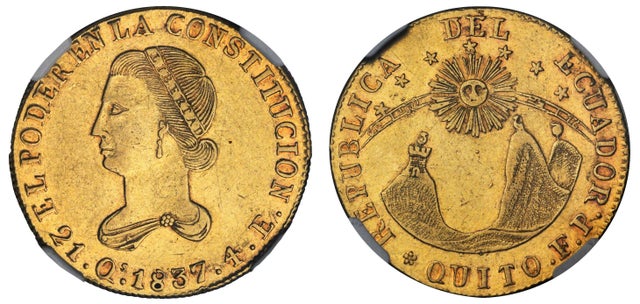
Known in the numismatic world as a "Moby Dick Coin," the Ecuadorian 8 Escudos doubloon, minted in Quito, Ecuador, between 1838 and 1843, is the one ounce of gold "sixteen dollar piece" Captain Ahab nails to the mast of the Pequod, promising it to the first man who "raises" Moby-Dick.. . . It is often confused for a "Spanish" doubloon, but this coin was not struck by the Spanish crown or endorsed by the Spanish government. The Moby Dick coin was minted in the Republic of Ecuador, at the Quito mint, many years after its independence from Spain
Doubloon = Moby-Dick = Moby Dick- Chapter 99 is interesting because of its many different interpretations of the doubloon. For instance, Flask only views the coin as “a round thing made of gold[,]” which means that he only sees the coin for its monetary value["] (Chapter 99). However, Fedallah perceives the doubloon to be reverential as he is a “fire worshiper” (Chapter 99, 348). These various viewpoints demonstrate not only the characters and their beliefs but also how one item can generate many thoughts and discussions. This novel is like the doubloon, as many people have different theories for what Moby Dick symbolizes and how the novel should be interpreted. This point is further supported in the next chapter when Ahab meets Boomer, a captain who also lost a limb to Moby Dick. Even though the two men experienced similar trauma, Boomer has moved on with his life and believes Ahab to be “crazy” for hunting Moby Dick (Chapter 100, 354). The comparison of the two men proves how everyone views the world differently.
Chapter 99 of [Moby-Dick] provides a fascinating mental exercise that essentially encapsulates the concept of the entire book; more specifically, the gold doubloon Ishmael presents to the crew reflects the variety of meanings one can take away from not only this particular scene, but the entirety of [Moby-Dick] .
- Many of their interpretations of the meaning of the coin reflect the many approaches to analyzing literature and art in general; for example, Ahab’s interpretation of the coin is expansive and broad, while Flask finds no meaning in the coin at all beyond monetary value. Stubb, on the other hand, initially struggles to find anything worthwhile looking at the coin but eventually finds beauty in his own reflection. Lastly, Quuqueg is simply amused by the coin’s resemblance to his tattoo. Each of these perspectives is a reflection of human nature and how not only we perceive literature, but the world around us.
- Chapter 99 serves to illustrate the differences between many of the characters aboard the Pequod. The characters analyze the gold coin that is nailed to the ship, with interpretations ranging from religious significance, self-reflection, prophecy, and “it’s literally a gold coin stop reading too much into it, you knobs[.]” . . . But my biggest takeaway was that this is another example of how the Pequod is a microcosm. We already know that the crew is diverse in religious beliefs, race, and nationality, and this chapter shows how their backgrounds influence their interpretation of seemingly mundane things, such as currency. This idea is best summed up in the line “all sorts of men in one kind of world” (Ch. 99).
- Stubb: "Book! you lie there; the fact is, you books must know your places. You'll do to give us the bare words and facts, but we come in to supply the thoughts" (Ch. 99).
Absence of Malice
- The whale-surgeon of the ship Samuel Enderby, referred to as Mr. Bunger, argued to the two whale-limbed captains that “the white whale’s malice is only his awkwardness[,]” and provides scientific proof that “the digestive organs of the whale are so inscrutably constructed by Divine Providence, that it is quite impossible for him to completely digest even a man’s arm” (Ch. 100). This [contributes] to the idea that the white whale is no malevolent creature, but simply acted in defense of itself or even possibly to provide heroic aid to “the pod of four of five whales” Captain Boomer had been harpooning for (Ch. 100).
- The shocking thing about this account is that the people giving it do not hold ill will to Moby Dick, even though he swallowed the captain’s arm. Bunger tries to defend Moby Dick to Ahab, detailing how whale stomachs are not capable of digesting limbs, so if a whale bites them off it is because of his “awkwardness” or self-preservation. Bunger and the captain clearly do not see whales as monsters, just animals. It calls into question their reasoning for becoming whalers in the first place; we have to wonder if they feel bad for hunting whales or if they see hunting as such a necessity that any sympathy for the whales is outweighed by the demand for oil.
- There is a very obvious split between Boomer and Ahab, especially in regard to hunting the whale. Ahab was maimed by the whale and now has sworn to kill it for revenge, but Boomer is happy to be alive and no longer worries about the whale because he saw how dangerous it was. “No more White Whales for me,” said Boomer (Ch. 100). Ahab is surprised and annoyed that Boomer would give up one the whale, but he has his reasons. He further explains, “there would be great glory in killing him, I know that...but, hark ye, he is best left alone...” (Ch. 100). Boomer seems to understand that life is more valuable than seeking revenge on the whale, and he chooses not to bother himself with it anymore. He is cheerful about his life and enjoys what he does. On the contrary, Ahab cannot comprehend why he would give up on the White Whale and intends to never do so until it is dead. To Boomer’s previous statement, Ahab replied, “He is. But he will still be hunted for all that” (Ch. 100). Although he recognizes the whale is better left alone, he refuses to do so. He is very unhappy with his life and exacting his revenge on the whale gives him a sense of purpose it seems. The clear opposition of each character's way of life makes me think there may be a deeper meaning to it. I think that Ahab may hate his disability so much that he thinks killing the whale will make him feel less horrible, and he is unhappy because of it. On the contrary, Boomer is content with his disability because he recognizes there is no point in trying to change what he cannot, and he is happier because of it.
- Ishmael muses that to write about his thoughts of whales makes him “faint with their outstretching comprehensiveness” and asks that he is given a “condor’s quill” and “Vesuvius’ crater for an inkstand” (Ch. 104). These requests and statement reflect the great lengths that Melville went to to describe various facts about whales and their anatomy and nature.
Monday, April 3, 2023
1820: Irving, Sleepy Hollow
Over the course of a month, Irving's party crossed thorugh a dozen Oklahom counties. (Chronicles of Oklahoma / Oklahoma Historical Society)
25. "Moby-Dick" (1851) by Herman Melville Chs. 133-135 and Epilogue
" "He raised a gull-like cry in the air. 'There she blows - there she blows! A hump like a snowhill! It is Moby Dick!'...
-
Cosmopolitanism Emphasizes global citizenship over national and local patriotism Values difference and "contamination" as a positi...
-
Wahunsenacah and the Powhatan The Powhatan homelands are in the Chesapeake Bay near present-day Virginia. At the time of first contact with ...
-
"Henry David Thoreau Study III" (2015) by Mathieu Laca Both of the texts below are excerpts from Walden (1854). Click here fo...