Sunday, April 9, 2023

1747: "The Speech of Miss Polly Baker" (1747)


"The Lost Portrait of Benjamin Franklin / Initiation" (2014) by Jordan Mendiola

The Speech of Miss Polly Baker (1747)

". . .I have hazarded the loss of the public Esteem, and frequenlty incurr'd public Disgrace and Punishment; and therefore ought, in my humble Opinion, instead of a Whipping, to have a statued erected in my Memory."

Ideology: Gender and Class

“The Speech of Miss Polly Baker” is a fictional work about a woman who struggles to have a fair trial.  It handles themes such as the equality of men and women under the law as well as some of Franklin’s religious thoughts.  Miss Polly Baker stands on trial for having children out of wedlock, and she says that this is the fifth time she has faced such charges.  She is poor, having “no Money to fee Lawyers to plead for me,” also adding a class aspect to the woman’s problem.  Baker talks about how she does not have any contempt for marriage, but even tried to be wed once, only to be abandoned with a child while the man continued on to be a magistrate.  She argues even further that she has worked for the good of society by reproducing, more so than the men who “leave unproduced” their posterity.  So it seems that Franklin is going against some of the Christian thoughts of the time to argue for a fair trial regardless of class or sex. 

Ideology: Church and State

. . . “The Speech of Miss Polly Baker” appeals for the acceptance of unmarried mothers, and abolishment of laws punishing adultery. One of the arguments made is that Ms. Baker, by being an unmarried mother of five children, has already, in their eyes, "offended Heaven, and must suffer eternal Fire” and asks “Will that not be sufficient?” If she has already been delivered spiritual reprisal, then why does she also deserve a legal one? In addition to this hypocrisy, another can be found that her former husband, an accomplice to her ‘crime,’ suffers no punishment at all, and has in fact found reward from the same system that apprehends her.

Ideology: What is Productivity?

One of the lines that I found thought-provoking was when Polly states "take into the consideration the growing number of bachelors, whom from fear of expense never honorably court a woman and live their lives unproduced. Is not theirs a greater offence to the public good”? It appears Ben Franklin is challenging the ideology of his time in a [satirical] way, pointing out the inequality faced by women. 

Ideology: A Woman's Voice

Something to point out too is that he wrote the story from the viewpoint of a woman, I presume he made this choice in an effort to give his argument more significance. Furthermore, it seems Franklin was perhaps wanting his male readers to look at the situation as if they were in a Polly’s shoes.

Aesthetics: Humor and SassFranklin seems to be using the argument of religion here, how God tells his people to be fruitful and multiply. Furthermore, Polly funnily states that she is determined, and her duty is one “of which nothing has ever been able to deter (her),” which to me sounds like she has been sexually active frequently and does not desire to stop. For her “duty,” she has “hazarded the Loss of the public Esteem.” Her continuous having children has led her to be estranged by society, and she feels that she is almost a martyr for it. I think this is funny, because it seems so dramatic. I do agree that she should not be punished for having sex or having children, but Polly seems like a very dramatic character in her sense of “duty.”


1784: "Remarks Concerning the Savages of North America" by Benjamin Franklin

"I" created the image above using the Midjourney server in Discord by typing these words: "forest landscape with Benjamin Franklin shooting a bow and arrow in the style of Thomas Cole."

Ideology: America vs. Book smarts

As the records smartly state, “different nations have different conceptions of things” (217). Where whites would need to know more math, science, and overall book smarts, Indians had to focus more on their physical capabilities to assure their survival within their tribes and maintain balance.

". . . if the gentlemen of Virginia will send us a dozen of their sons, we will take great care of their education, instruct them in all we know, and make men of them" (217).

Ideology: Imperialism, Cosmopolitanism, and Difference

  • Franklin opens . . . by saying “Savages we call them, because their manners differ from ours, which we think the Perfection of Civility; they think the same of theirs.”  Establishing that both sides think themselves to be in the right, he continues on to discuss which ones are truly the more civilized.  He notes their politeness, hospitality, etc., all of which exceed that of the whites.  Franklin proved to be quite open-minded about a number of things as wonderfully shown in these treatises.
  • . . .  when NativeAmericans are asked to respond to another group of people, they are determined “not to answer a public proposition the same day that it is made.” As Franklin mentions, this is a sign of respect towards the waiting party among the Native Americans. He uses this metaphor to liken the beliefs of the Native Americans to respecting differences among nations; furthermore, even the title appears to be a jab at those who are unable to understand this concept, with “Remarks Concerning the Savages of North America” playing up the exaggerated hatred towards North Americans.
  • . . .  Native Americans that have been victimized by prejudice and labeled "savage," but are in fact infinitely more well-mannered and civilized in diplomatic nature than most adherents to industrial civilization. This can be seen in his writing when he states “The Indians hear with patience the truths of the Gospels explained to them, and give their usual tokens of assent approbation; you would think they were convinced. No such matter. It is mere civility.”
  • My favorite line of the entire record Franklin preserved was when the leader of the Indian tribe said “‘You saw that we… believed all your stories; why do you refuse to believe ours.’” Something about this line was so raw and powerful to me. We’re always taught to believe in everything, yet also taught to shun anything that doesn’t fit in our ‘vision’ or teachings. The way he says this shows just how closed minded we are as a nation as we refuse to listen to other standpoints, which is very true for the generation we’re now seeing today.
  • "My brother, it seems your friends have not done you justice in your education; they have not well instructed you in the rules of common civility. You saw that we, who understand and practice those rules, believed all your stories; why do you refuse to believe ours?"

1787: The Federalist, No. 1, by Alexander Hamilton, and No. 10, by James Madison

Lin-Manuel Miranda as "Alexander Hamilton" and Okieriete Onaodowan as "James Madison" in Hamilton: An American Musical (2015)

Ideology: America as Empire, Common Interest vs. Self-Interest
No. 1 of The Federalist Papers opens up with a discourse on the importance of the document and the reason for it. Hamilton writes in this section about the failure of the Articles of Confederation and “nothing less than the UNION, the safety and welfare of the parts of which it is composed, the fate of an empire in many respects the most interesting in the world.” He sets up the discussion by categorizing those who opposed the new Constitution, and he says that it is these men who “resist all changes” who prove to be “the most formidable of the obstacles which the new Constitution will have to encounter.
Consider this Enlightenment question:  "whether societies of men are really capable or not of establishing good government from reflection and choice, or whether they are forevere destined to depend, for their political constitutions, on accident and force" (362)

Consider the appeal of self-interest (self-reliance): "Among the most formidable of the obstacles which the new Constituion will have to encounter may readily be distinguished the obvious interest of a certain class of men in every state to resist all changes which may hazard a diminution of the power, emolument, and consequence of the offices they hold under the state of establishments--and the perverted ambition of another class of men, who will either hope to aggrandize themselves by the confusions of their country, or will flatter themselves with fairer prospects of elevation from the subdivision of the empire into several partial confederacies, than from its union under one government" (362-363)

Ideology:  American Representative Democracy vs. Factionalism
No. 10 is the first of Madison’s writings in The Federalist Papers, and its primary theme is the new Union’s ability to “break and control the violence of faction.” One of the problems with the Articles of Confederation is that they did not provide a strong enough national government; one of the advantages of the new Constitution would be that it would not favor any one group, but it would be a strong central government which looks for the common good for all. “Pure democracy,” as Madison puts it, “can admit of no cure for the mischiefs of faction.” Only a representative democracy allows for every voice to be heard instead of being drowned out by the masses.

I liked the way Hamilton described the intentions of those who hold beliefs that opposed one’s own beliefs. He said that people should “mutually hope to evince the justness of their opinions” and believe that there is only good in their intentions. I think that if everyone had this point of view about the ideas of others, there would be a lot less conflict in politics especially, and more conversations about important issues would be had.

Consider cosmopolitanism:  "nothing could be more ill judged than that intolerant spritis, which has, at all times, characterized political parties" (363)

Consider the threat to cosmopolitanism:  "Men of factious tempers, of local prejudices, or of sinister designs may, by intrigue, by corruption, or by other means, first obtain the suffrages, and then betray the interests of the people" (368)

"The smaller the society . . . the more easily will they concert and execute their plans of oppression" (369)

Ideology: Head and Heart, Restraint and Passion
What I found most interesting about The Federalist excerpts, particularly No. 1, was the humility and transparency the author implemented into their writing. Considering the passion behind those pushing for the ratification of the Constitution, the restraint seen in the writing is remarkable; for example, he describes endangering the rights of the people as “more commonly the fault of the head than of the heart,” a bold statement to make about government when trying to gain sympathy for your own government. When speaking about how government officials require honesty in their actions, he follows this by saying “my arguments will be open to all, and may be judged by all.” Clearly, this is an appeal to the hearts of the public, who are often distrustful of government officials. Especially looking at our own government today, the transparency and honesty in this argument is almost alien when reading this in modern America.

Consider the threat of passions:  ". . . as in all former cases of great national discussion. A torrent of angry and malignant passions will be let loose. . . . they will mutually hope to evince the justness of their opinions, and to increase the number of their converts by the loudness of their declamations, and by the bitterness of their invectives" (363).

Saturday, April 8, 2023

21A. "Moby Dick" (1851) by Herman Melville, Chs. 96-105


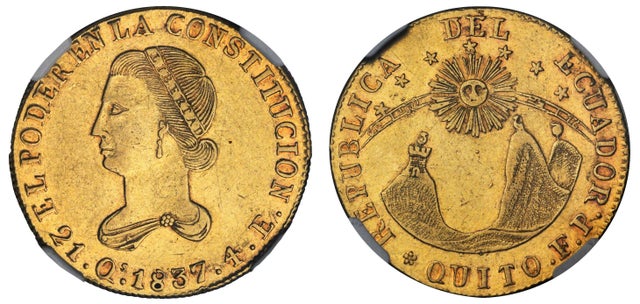
Known in the numismatic world as a "Moby Dick Coin," the Ecuadorian 8 Escudos doubloon, minted in Quito, Ecuador, between 1838 and 1843, is the one ounce of gold "sixteen dollar piece" Captain Ahab nails to the mast of the Pequod, promising it to the first man who "raises" Moby-Dick.. . . It is often confused for a "Spanish" doubloon, but this coin was not struck by the Spanish crown or endorsed by the Spanish government. The Moby Dick coin was minted in the Republic of Ecuador, at the Quito mint, many years after its independence from Spain

Doubloon = Moby-Dick = Moby Dick
  • Chapter 99 is interesting because of its many different interpretations of the doubloon. For instance, Flask only views the coin as “a round thing made of gold[,]” which means that he only sees the coin for its monetary value["] (Chapter 99). However, Fedallah perceives the doubloon to be reverential as he is a “fire worshiper” (Chapter 99, 348). These various viewpoints demonstrate not only the characters and their beliefs but also how one item can generate many thoughts and discussions. This novel is like the doubloon, as many people have different theories for what Moby Dick symbolizes and how the novel should be interpreted. This point is further supported in the next chapter when Ahab meets Boomer, a captain who also lost a limb to Moby Dick. Even though the two men experienced similar trauma, Boomer has moved on with his life and believes Ahab to be “crazy” for hunting Moby Dick (Chapter 100, 354). The comparison of the two men proves how everyone views the world differently.

  • Chapter 99 of [Moby-Dick] provides a fascinating mental exercise that essentially encapsulates the concept of the entire book; more specifically, the gold doubloon Ishmael presents to the crew reflects the variety of meanings one can take away from not only this particular scene, but the entirety of [Moby-Dick] .

You are how you read?
  • Many of their interpretations of the meaning of the coin reflect the many approaches to analyzing literature and art in general; for example, Ahab’s interpretation of the coin is expansive and broad, while Flask finds no meaning in the coin at all beyond monetary value. Stubb, on the other hand, initially struggles to find anything worthwhile looking at the coin but eventually finds beauty in his own reflection. Lastly, Quuqueg is simply amused by the coin’s resemblance to his tattoo. Each of these perspectives is a reflection of human nature and how not only we perceive literature, but the world around us.
  • Chapter 99 serves to illustrate the differences between many of the characters aboard the Pequod. The characters analyze the gold coin that is nailed to the ship, with interpretations ranging from religious significance, self-reflection, prophecy, and “it’s literally a gold coin stop reading too much into it, you knobs[.]” . . .  But my biggest takeaway was that this is another example of how the Pequod is a microcosm. We already know that the crew is diverse in religious beliefs, race, and nationality, and this chapter shows how their backgrounds influence their interpretation of seemingly mundane things, such as currency. This idea is best summed up in the line “all sorts of men in one kind of world” (Ch. 99).
  • Stubb:  "Book! you lie there; the fact is, you books must know your places. You'll do to give us the bare words and facts, but we come in to supply the thoughts" (Ch. 99).

Absence of Malice

  • The whale-surgeon of the ship Samuel Enderby, referred to as Mr. Bunger, argued to the two whale-limbed captains that “the white whale’s malice is only his awkwardness[,]” and provides scientific proof that “the digestive organs of the whale are so inscrutably constructed by Divine Providence, that it is quite impossible for him to completely digest even a man’s arm” (Ch. 100). This [contributes] to the idea that the white whale is no malevolent creature, but simply acted in defense of itself or even possibly to provide heroic aid to “the pod of four of five whales” Captain Boomer had been harpooning for (Ch. 100). 
  • The shocking thing about this account is that the people giving it do not hold ill will to Moby Dick, even though he swallowed the captain’s arm. Bunger tries to defend Moby Dick to Ahab, detailing how whale stomachs are not capable of digesting limbs, so if a whale bites them off it is because of his “awkwardness” or self-preservation. Bunger and the captain clearly do not see whales as monsters, just animals. It calls into question their reasoning for becoming whalers in the first place; we have to wonder if they feel bad for hunting whales or if they see hunting as such a necessity that any sympathy for the whales is outweighed by the demand for oil.
  • There is a very obvious split between Boomer and Ahab, especially in regard to hunting the whale. Ahab was maimed by the whale and now has sworn to kill it for revenge, but Boomer is happy to be alive and no longer worries about the whale because he saw how dangerous it was. “No more White Whales for me,” said Boomer (Ch. 100). Ahab is surprised and annoyed that Boomer would give up one the whale, but he has his reasons. He further explains, “there would be great glory in killing him, I know that...but, hark ye, he is best left alone...” (Ch. 100). Boomer seems to understand that life is more valuable than seeking revenge on the whale, and he chooses not to bother himself with it anymore. He is cheerful about his life and enjoys what he does. On the contrary, Ahab cannot comprehend why he would give up on the White Whale and intends to never do so until it is dead. To Boomer’s previous statement, Ahab replied, “He is. But he will still be hunted for all that” (Ch. 100). Although he recognizes the whale is better left alone, he refuses to do so. He is very unhappy with his life and exacting his revenge on the whale gives him a sense of purpose it seems. The clear opposition of each character's way of life makes me think there may be a deeper meaning to it. I think that Ahab may hate his disability so much that he thinks killing the whale will make him feel less horrible, and he is unhappy because of it. On the contrary, Boomer is content with his disability because he recognizes there is no point in trying to change what he cannot, and he is happier because of it.
The Great Writing Challenge
  • Ishmael muses that to write about his thoughts of whales makes him “faint with their outstretching comprehensiveness” and asks that he is given a “condor’s quill” and “Vesuvius’ crater for an inkstand” (Ch. 104). These requests and statement reflect the great lengths that Melville went to to describe various facts about whales and their anatomy and nature.
Ishmael is Black?
More evidence is also provided for Ishmael’s ethnicity in chapter 104. Ishmael states that he has worked as a “stone-mason, and also a great digger of ditches, canals and wells, wine-vaults, cellars, and cisterns” (Ch. 104). These are jobs, except possibly stone-mason, that were considered undesirable to many in the 1800s and would be taken up by people of color of those who were not qualified to work other jobs. This could be evidence that Ishmael truly is African American rather than Caucasian. 

Ishmael as Reader
Throughout chapter 103 and 104, Ishmael attempts to describe Sperm Whales from their skeletons alone. Ishmael even states that he was “struck anew” by the “majestic” build of Sperm Whales (Chapter 103). He goes on to say that trying to capture the “magnitude” of the creature is a “vain and foolish” act for a man that is “timid” and “untraveled” (Chapter 103). This implies that just as Ishmael cannot admire or “comprehend” Sperm Whales, the reader cannot fully understand what the novel symbolizes without looking at all its parts (Chapter 103). In order to grasp what Melville is trying to convey in Moby-Dick, the reader has to dissect every chapter and character, not just the areas that they enjoy.

Monday, April 3, 2023

1820: Irving, Sleepy Hollow

The painting above, by Christian Schussle, was completed in 1864, five years after the death of Washington Irving. It is titled "Washington Irving and his Literary Friends at Sunnyside." South of Tarrytown and Sleepy Hollow, Sunnyside was Irving's home on the banks of the Hudson River in New York between 1835 and his death in 1859. The painting demonstrates Irving's prominence in American literary history of the period. That's Irving sitting in the center with his legs crossed. The other writers portrayed are, from left to right, Henry T. Tuckerman, Oliver Wendell Holmes Sr., William Gilmore Simms, Fitz-Greene Halleck, Nathaniel Hawthorne, Henry Wadsworth Longfellow, Nathaniel Parker Willis, William H. Prescott, (Irving), James Kirke Paulding, Ralph Waldo Emerson, William Cullen Bryant, John Pendleton Kennedy, James Fenimore Cooper, and George Bancroft.

New York City
Irving published his first satirical essays on theatre and New York City society in 1802, when he was nineteen years old (Irving was born in New York City).

Poking Fun at Knickerbockers
Irving first achieved literary celebrity with a parodic work titled A History of New-York from the Beginning of the World to the End of the Dutch Dynasty, which made fun of a more serious history published by another author in 1807 (The Picture of New York by Samuel Lathen Mitchell). Irving's book was narrated by "Diedrick Knickerbocker." 

The Best-Known American Writer in Europe
Irving lived in Europe between 1815 and 1832. It was there that he wrote "The Legend of Sleepy Hollow" in 1819.

The publication in 1820 of The Sketch Book of Sir Geoffrey Crayon, which included "The Legend of Sleepy Hollow" and "Rip Van Winkle," helped establish Irving as "one of the 'inventors' of the modern short story" (Levine 511).

Irving was "the first American writers of the 19th century to achieve an international literary reputation"  and "the first American able to support himself solely through his writing" (Levine 511).

St. Christopher
In 1824, Irving moved to Spain, and four years later, he published a non-fiction history The Life and Voyages of Christopher Columbus, "which became the basis for standard schoolroom accounts of Columbus during the nineteenth and early twentieth centuries" (Levine 512).  The book was "stunningly inaccurate." For example, "The real Columbus studied Portuguese sailors’ maps, concluded that Southeast Asia lay just beyond the map edges, and set out to prove it. Irving’s Columbus sailed to prove that the world was round, thumbing his nose at European elites who insisted it was flat. Throughout the book, Columbus is valiant, intrepid, and eager to shed Old Europe—not coincidentally, exactly the qualities the United States saw in itself" (Burmila).

Oklahoma!
After returning to the States in 1832, he took a horseback journey into Oklahoma and subsequently published a book about his experiences (A Tour of the Prairies, 1835).


Over the course of a month, Irving's party crossed thorugh a dozen Oklahom counties. (Chronicles of Oklahoma / Oklahoma Historical Society)

20B. "The Legend of Sleepy Hollow" (1820) by Washington Irving


Aesthetics: Humor

  • Irving’s description of Ichabod cracked me up, especially when they said he could be “mistaken him for the genius of famine descending upon the earth, or some scarecrow eloped from a cornfield” definitely pushing the fact that he’s a thin wisp of a man (Irving).
  • a fascinating protagonist with a fun mish-mash of endearing and charming traits, like his psalmody singing which “resounded far above all the rest of the congregation”, alongside more concerning qualities, such as his adherence to the “golden maxim” of “Spare the rod and spoil the child” and his variety of strange features with his most vivid description being his nose that “looked like a weather-cock perched upon his spindle neck”(Irving).
  • Gunpowder . . . was an old plow-horse, who had “outlived everything but his viciousness.” The horse was described in an unattractive manner, having a “rusty mane and tail (that) were tangled with burrs.” He also had an “ewe neck and a head like a hammer” (Irving).Overall, the horse was described in an unlovely [manner], having been worked into this shape. Gunpowder seems to be a parallel to Ichabod himself-a beaten down and rough man, not very attractive, but gets the job done. He was a sort of outcast and low-class. On the contrary, Brom Bone’s horse is much like his character. Bones is a proud and sneaky person. Like Ichabod and Gunpowder, Bonas’s horse called Daredevil is much like his owner. Daredevil was a proud steed, “full of mettle and mischief.” Bone’s horse possessed that mettle and mischief of “which no one but himself could manage.” Daredevil was also known to perform tricks “which kept the rider in constant risk of his neck.” This parallel between animal and owner was echoed in Bones as it was with Ichabod and gave way to a humorous imagining of each man in relation to his horse. 
  • Despite the story having dark undertones, it’s oddly humorous and seems to have a narrow focus on heads and food. Why Irving chose these two topics to focus on and write over is a mystery to me, but the mere fact that those are the subjects most often discussed made the story funnier than it was probably meant to be

    SB:  It is meant to be funny.
Aesthetics: The Cultural Afterlife of The "The Legend of Sleepy Hollow"
  • I have seen a stage production of this story before, but this is the first time I have ever read it. It is still just as interesting and captivating, but there seems to be a different emphasis. Ichabod is a teacher who enjoys reading stories and is rather imaginative, and the rest of the town of Sleepy Hollow is filled with superstitious people who are “given to all kinds of marvelous beliefs; are subject to trances and visions; and frequently see strange sights, and hear music and voices in the air” (6). One thing which surprises me quite a bit is the comical aspect of the story. The stage production and other times which I have heard the story always treated it like a short horror story which is rather serious, but this one ends with the townspeople thinking that Ichabod’s story of the Headless Horseman chasing after him to just be a prank pulled on him by Brom Bones.
Aesthetics: The Reader (and Brom) Know
  • I wondered if Brom Bones is actually the headless horseman, and the legend continued because Brom Bones would run off any outsiders that came to their town. I believe the “head” was a pumpkin because of the descriptions of autumn in the beginning of the story.
  • It is interesting that the story is told from a set of papers belonging to “the late Diedrich Knickerbocker” instead of an alive and present narrator. Maybe Irving did this to make the story appear more realistic or historical, as if he wanted the readers to believe that the story had actually been found among the belongings of a dead man who heard the tale from someone (a stranger during a business meeting) who also heard the tale. It is because of this that I think the story of Ichabod Crane is something Irving wanted the reader to question. For instance, the gentleman who originally told the story to Knickerbocker said that he “[didn’t] believe one half of it” after spouting a confusing syllogism. There is also the matter of Brome Bones who “always bursts into a hearty laugh” when the ending of the story is told, implying that he knows more about the story [than] others. If [Brom] does know what happened to Ichabod, it further supports the idea that the reader should not trust what Ichabod saw the night he fled Sleepy Hollow.
  • The story has an ambiguous ending (kind of). We find out that the thing the headsman was carrying was a pumpkin rather than a head, and at the end of the story Brom laughs off any questions about the night Ichabod went missing. Both of these events point to Brom being the headless horsemen, since he didn’t want Katrina to pick Ichabod over him. However, some of the logistics of this questionable. Such as, how did Ichabod not recognize Brom? Or how did Brom catch up to Ichabod? Why would Brom feel the need to run Ichabod out of town when Katrina rebuffed him at the end of the party? I feel like those first two questions have easy answers; Ichabod didn’t recognize Brom because it was dark and even when Ichabod slowed the horseman didn’t catch up. Brom is also a skilled horseman who is originally from Sleepy Hollow, meaning that he knew shortcuts in the area. As for the question about Katrina, I feel like there is an answer to this; Brom is a jock. I know that is a modern term, but it fits Brom to a tee. All the characters in this story are stereotypes; Ichabod is the nerd, Brom is the jock, and Katrina is the love interest whose only character traits are how much she is coveted by the leading men. Brom’s characterization is that he wants to solve everything with brute force, trying to goad Ichabod into a brawl over Katrin. Even though Katrina rebuffed Ichabod, she had not officially chosen Brom, so Brom still felt threatened. Dressing up as the horseman and knocking Ichabod unconscious with a pumpkin lines up alarmingly well with his prior characterization. I don’t know if Irving wanted this ending to be ambiguous and unnerving or if he trusted his readers to figure the ending out, but these obvious clues point to the latter.
  • Finally, something very hard to miss to me was the comparison of Daredevil performing tricks which would “keep the rider in risk of his neck.” The neck comment struck me as odd and felt like a clue at [Brom's] being the Headless Horseman, with it having no head. Also, If Daredevil were so connected with his owner, and able to do such tricks, it would be easy for them to attack Ichabod as he was attacked. Further clues towards the end of the story also indicated this being truth, with [Brom's] amusement at the disappearance of Ichabod
  • Ichabod probably thought, since he was such a believer in the old tale, that it really was the Headless Horseman who assailed and chased him. He probably never even thought that it could be Brom Bones. Or perhaps he did but was so embarrassed by the prank and his dismissal from the heiress that he thought it best to never return.
Ideology: Brom as Hero?  
  • I still find myself dumbfounded on the unrequited cruelty enacted upon Ichabod.
Ideology: Intellectual Life
  • On the subject of stereotypes, I do want to point out that Ichabod subverts his stereotype a little when it comes to the treatment of his school children. He hits them, but only the ones that are not already afraid of him. Instead, he gave “a double portion on some little tough wrong-headed, broad- skirted Dutch urchin”. He’s a bully just as much as Brom is, but because he is lanky and nerdy and runs away from his problems in the end, he still fits the nerd stereotype. Brom also slightly subverts his stereotype by using trickery. He could never goad Ichabod into a direct fight, so he exploited Ichabod’s known fear of ghost stories to run him out of town. He still resorted to brute force when he chucked the pumpkin at Ichabod’s head and injured him, but he had to come up with a clever way to get to that point since Ichabod was too smart to fight him one-on-one. The only main character who doesn’t subvert their stereotype at all is Katrina. (But this was in the 1800’s so, like, who’s surprised?)
  • It is made known from the beginning that Ichabod is a poor schoolteacher whom “to see striding along the profile of a hill on a windy day, with his clothes bagging and fluttering about him, one might have mistaken him for the genius of famine descending upon the earth, or some scarecrow eloped from a cornfield.["] However, it seems while he appeared to be helpful toward the residents, they kind of saw him as a bit a of a mooch without a real means of making money. As is stated, “might not be too onerous on the purses of his rustic patrons, who are apt to consider the costs of schooling a grievous burden, and schoolmasters as mere drones.” Moreover, Ichabod himself seemed to hold some prejudices himself as he is described as someone who “administered justice with discrimination rather than severity, taking the burden off the backs of the weak, and laying it on those of the strong.” Furthermore, he seemed to “prey” on the students of families who had “pretty sisters and housewives noted for the comforts of the cupboard.” Perhaps, it one of the prime reasons he went after Katrina. Maybe that is why he was “chased down” by the headless horseman.
Cultural Context: American Identity Narrative
Compare with:
  • "Calathumps" (1825) at the University of Virginia. See: Richard Bernstein's 2003 biography Thomas Jefferson'; Mr. Jefferson's University: A History (1981) by Virginius Dabney,"Letter to Joseph Coolidge, Jr., 13 October 1825" by Thomas Jefferson; The Sage of Monticello (1981) by Dumas Malone.
  • Charlotte Temple (1791) by Susanna Rowson (America's first best-selling novel)
  • The Contrast (1790) by Royall Tyler (the first professionally produced play written by an American author)
  • The Lion of the West (1831)by James K. Paulding
  • Life of George Washington (1809) by Mason Locke Weems
  • Biographical Memoir of Daniel Boone (1834) by Timothy Flint
  • Davy Crockett's Own Story (1833) by Davy Crockett
  • "The Turn Out" (1833) by Augustus Baldwin Longstreet
  • In 1839, the University of Virginia's faculty chairman "was assaulted by two students and horsewhipped while at least one hundred other students looked on and did nothing to stop the outrage" (Dabeny 9).
  • In 1841, another faculty chairman attempt to stop a masked student from firing shots on the Lawn in front of his residence, and ths student shot and killed him (Dabney, 9).

Monday, February 6, 2023

Notes and Considerations

Above: "Boundless" (2008) by Shelly Niro

We don't always get through everything I hope to in class discussions, so moving forward, I hope to use this space to add important notes and questions for consideration.

Thoreau, Walden

1. Consider the ways that Thoreau’s discourse echoes Marxism and Romanticism as competing paradigms for describing "progress." While Thoreau’s criticisms of consumerism and the extravagant lifestyles of the wealthy seem aligned with Marxist critiques of capitalism, Marxists are advocates for sharing wealth, not shunning it. Marxists believe that capitalism represented a kind of progress that would be surpassed by a subsequent stage of progress: communism. On the other hand, there is an element of Romanticism in Thoreau’s references to the inhabitants of Tierra del Fuego, “naked savages” who are heartier than more civilized explorers, whom Enlightenment thinkers might consider to be more advanced.

2. Walden may be read as a forceful response to anyone who argues that it is not practically possible to just check out from society and live independently. Thoreau suggests that we think we need much more than we really do.

3. Consider: Do Harding Davis, Alcott, Whitman, and Douglass agree with Thoreau that the mass of men lead lives of quiet desperation? To the extent that they do, do they agree on who is responsible for this?

4. Consider: Is Thoreau's ultimate goal to lead a simple life or is it to elevate "mankind"? Or does he think that the first can lead to the second?

Douglass, Narrative of the Life of Frederick Douglass

1. Douglass’s matter-of-fact tone, his literary references, and his eloquence helps depict him as a serious intellectual and counters racist notions that Blacks were inferior to Whites.
Example one: “[Mr. Gore] raised his musket to [Demby’s] face, taking deadly aim at his standing victim, and in an instant poor Demby was no more. His mangled body sank out of sight, and the blood and brains marked the water where he had stood.”
Example two: Sails on the Chesapeake Bay

Consider: The following passage is one of the most often excerpted passages from Douglass's Narrative, partially because it makes use of several classical literary devices, such as apostrophe, antithesis, and personification.

I was sometimes prompted to take my life, and that of Covey, but was prevented by a combination of hope and fear. My sufferings on this plantation seem now like a dream rather than a stern reality.

Our house stood within a few rods of the Chesapeake Bay, whose broad bosom was ever white with sails from every quarter of the habitable globe. Those beautiful vessels, robed in purest white, so delightful to the eye of freemen, were to me so many shrouded ghosts, to terrify and torment me with thoughts of my wretched condition. I have often, in the deep stillness of a summer’s Sabbath, stood all alone upon the lofty banks of that noble bay, and traced, with saddened heart and tearful eye, the countless number of sails moving off to the mighty ocean. The sight of these always affected me powerfully. My thoughts would compel utterance; and there, with no audience but the Almighty, I would pour out my soul’s complaint, in my rude way, with an apostrophe to the moving multitude of ships:—

“You are loosed from your moorings, and are free; I am fast in my chains, and am a slave! You move merrily before the gentle gale, and I sadly before the bloody whip! You are freedom’s swift-winged angels, that fly round the world; I am confined in bands of iron!


2. Consider: Can Douglass’s experiences learning to read (knowledge empowered him and it was painful for him) be applied to high school and college students and American society more broadly?

3. Consider: Is it fair to criticize Douglass’s account of his struggle with Covey for suggesting that slaves who didn't fight back were to some extent responsible for their own suffering?

4. Consider: While in his "1845 Narrative, [Douglass] presented himself as relatively isolated from his fellow slaves, describing his fight with Covey as a heroic instance of individual rebellion; in the 1855 My Bondage and My Freedom, he depicted the fight as involving several other African Americans who came to his assistance" (The Norton Anthology of American Literature, Shorter Ninth Edition: Beginnings to 1865, 999).

5. Consider: Does Douglass’s Narrative marginalize or minimize the struggles and the strength of Black women?

7. Consider: To what extent can Douglass’s Narrative be read as a condemnation of Christianity and to what extent can be read as a condemnation of the Christianity of the slave owners?

6. Consider: Should reading gruesome passage from slave narratives be encouraged in high school? Should it be required in college?

Melville, Moby-Dick

Chs. 15-18

1. Ishmael’s efforts to talk Queequeg out of his fasting practices raise interesting questions about the differences between cultural imperialism, cosmopolitanism, multiculturalism, and cultural protectionism.

2. Peleg and Bildad’s eagerness to hire Queequeg after he demonstrates his prowess as a harpooner raises questions about the relationship between commercial interests and religious and cultural concerns; Mrs. Husssey’s response when she thought Queequeg had killed himself suggests that her primary concern is profit.

Consider: If New Bedford is a model of cosmopolitanism, what role does capitalism play in its culture?

Chs. 19-21

1. Elijah is a Biblical prophet who predicted the destruction of Ahab, who was an unfaithful King, who worshipped Baal. Jezebel was Ahab’s wife.
2. Elijah’s prophesies raise questions about the role of human agency in determining the shape our lives take.

Chs. 22-28
1. Elijah's prophecies and The Pequod's "blind plunge" into the lone Atlantic raise questions about fate, predestination, and human agency.
2. Consider: can Ishmael's defense of the whaling industry be read as a defense of the working class and as America as a democratic nation that depends on ordinary citizens to shape its political future?
3. To be continued ...

Chs. 29-32
1. Consider: How might thinking of Ahab as an amputee and trauma victim affect reader responses to his thoughts and behavior?
2. The Cetology chapter provides yet another example of the great variety of writing styles on display in the novel, appearing as it does among other chapters that have passages that read like poetry, others like stage plays or sermons, others narrated by an omnisicent voice, and others that read like dramatic monologues. This variety may be considered an embodiment of a fractured modern world in which the Protestant reformation, democratic revolutions, and secular humanism of the Enlightenment have ruptured once relatively stable religious, political, and intellectual structures (compare with cubist paintings like "Les Demoiselles d'Avignon" [1907], which shattered conventional viewer expectations of visual representation). 
3. Despite the extensive knowledge the Cetology chapter presents about whales, the narrator concludes that seeking understand these animals who live behind an "inpenetrable veil" in "unfathomable water" is ultimately futile. The human capacity for understanding is limited; the promise of the Enlightenment may be overstated.
4. Ishmael's decision to classify whales as "fish," though scientist have, in fact, categorized them as mammals, as Ishmael is aware, may demonstrate his skepticism about the classification schemes of scientific experts (and, perhaps, the Enlightenment project, more broadly speaking).

Chs. 33-36
1. The bliss Ishmael experiences on the masthead is comparable to the freedom Thoreau described when he went into the woods and removed himself from the demands of capitalist, consumer society. Both urges are rooted in Romantic criticism of "society" as a source of conformity and Romantic celebrations of nature of a source of strength and rejuvenation.
2.  The crew's enthusiastic response to Ahab's recruitment speech (Ch. 36) suggests that democracies may be vulnerable to demagogues who enlist them in a campaign to attack the "Other." Compare with Napoleon's emergence as a dictator in the aftermath of the French Revolution.

Chs. 37-39
1. The "Iron Crown of Lombardy," which Ahab describes himself as wearing (Ch. 37), was also worn by Napoleon, and it was said to contain a nail from the crosson which Jesus was crucified. The reference links Ahab to both of these figures and challenges readers to reflect on whether they seem him as a tyrant, a martyr, or a redeemer.
2. Chapter 37, 38, and 39, offer a variety of attitudes towards fate and human agency. Ahab is determined to be the master of his own fate. Starbuck is torn between the professional loyalty he owes to his commander and the duty he feels to his own conscience and the stated (commercial) mission of the Pequod. Stubb cheerfully accepts the fact that his fate is predetermined.

Chs. 46-49
1. In Chapter 44, we read a description of Ahab suffering from “trances of Torment,” which suggests that he may be suffering from a mental illness (obsessive thoughts). In Chapter 46, Ahab demonstrates a keen awareness of how his behavior might be perceived as unhealthy by the sailors. He may be unwell, but he is not completely detached from reality and self-awareness. He understands how he is seen by others.
2. In Chapter 47, Melville turns a description of the mat-making process into a reflection on fate, human agency, and predestination, where the warp represents God’s will/predestination; the sword represents chance; and the shuttle represents free will. All work together. All play a role. This chapter also includes passages that are richly poetic.
3. Consider: Does describing Fedallah's crew as "tiger yellow creature" and comparing them to "infidel sharks . . .with "eyes of red murder" undermine the kind of cosmopolitan tolerance that is celebrated in other parts of the novel?


Stowe, Uncle Tom’s Cabin (1852)

1. Given the way Uncle Tom’s Cabin became a successful (and racist?) franchise, consider: to what extent can we hold the original text and its author accountable for the text’s subsequent cultural life? Are the seeds of the novel’s troubling cultural afterlife embedded in the text?

2. James Baldwin hated Uncle Tom’s Cabin because of its sentimental and unrealistic portrait of the character of Uncle Tom, which he considered to be both emasculating and dehumanizing. Jane Tompkins (Sensational Designs, 1985) celebrated it because it offered a radical political alternative to a patriarchal status quo. Frederick Douglass praised the novel for igniting outrage against the institution of slavery. Andrew Delbanco (The War Before the War, 2018) says that Stowe is a "proto-Marxist" because although Stowe intended her novel to to be about how “conscience," in fact, "material interests" repeatedly prevail in the novel. 

3.  Don’t miss the many examples of Stowe’s sarcasm in Chapter Twelve (and elsewhere).

4. Consider the limitations of textual power to constrain interpretation in the context of the discussion of the Biblical support for slavery on La Belle Riviere.

Jacobs, Incidents in the Life of a Slave Girl (1861)

Chs. 1, 7 10
1. The Dictionary of North Carolina Biography entry on Dr. James Norcom, Sr., the man referred to as “Dr. Flint” in Jacobs’s narrative, is chilling in the way it describes Norcom as an upstanding, accomplished and otherwise normal member of society (his career as a slaver is tacked on at the end).

2. Jacobs’s book is the first slave narrative authored by a Black woman in America.

3. In time, scholars came to believe that Jacobs's book was a novel. Some believed it was actually authored by Lydia Maria Child, the well-known white writer who helped Jacobs edit and publish it. In the 1980s, research done by historian Jean Fagin Yellin established "that this was an autobiographical narrative and not a novel" and as a result, the book enjoyed "belated acclaim"

Chs. 14, 17, 18, 19, 20, 21
1. On one hand, the slave is treated as animal property: a brute resource to be exploited for profit. Yet, on the other hand, after Linda escapes, Dr. Flint's obsession with finding and capturing her surpasses the bounds of commercial or market rationality: ". . . Dr. Flint cared even more for revenge than he did for money."
2. Dr. Flint's deranged protestations about the way Linda treats him suggest that he believes that his treatment of her was truly admirable. The human capacity for flatttering self-delusion is staggering.
3. Flint's plans to build an isolated cabin where he could rape Linda without his wife being able to catch him in the act remind us that the institution of slavery did not just deprive slaves of wages for their labor and treat human beings a commodities to be exploited. It facilitated mass rape of black women by white men.
4. Incidents in the Life of a Slave Girl helps illustrate how slavery's abuses extended far beyond whipping and other forms of corporal punishment.
5. Jacobs's feelings of gratitude to the slaveholding woman who helps her challenges readers with a worldview that allows both for exteme villainy and extraordinary moral complexity. 

25. "Moby-Dick" (1851) by Herman Melville Chs. 133-135 and Epilogue

  " "He raised a gull-like cry in the air. 'There she blows - there she blows! A hump like a snowhill! It is Moby Dick!'...